
Antler Bio has transformed EpiHerd from a promising epigenomics concept into a commercially available herd management platform, helping dairy farmers make better decisions about nutrition, health and productivity. Along the way, the business has secured multiple Innovate UK-funded projects, attracted private investment, generated its first revenues and expanded into international markets.
With support from the UK Agri-Tech Centre, Antler Bio was able to demonstrate the technology in commercial dairy systems, refine it around farmers’ needs and build the evidence and industry confidence required to move from scientific innovation to commercial adoption.
Impact at a glance…
- Technology readiness: TRL 2-3 (concept formulated) to TRL 7-8 (technology proven through test and demonstration)
- Commercial adoption: EpiHerd deployed on around 150 dairy farms
- Investment secured: €4.85 million private investment raised across three funding rounds
- Employment: Team expanded from three to nine full-time employees
- Innovation pipeline: Three successive Innovate UK-supported projects advancing the EpiHerd platform
The challenge
Founded in 2021, Antler Bio developed an epigenomics platform capable of analysing how environmental factors influence gene expression in livestock. Unlike conventional genomic testing, which identifies an animal’s genetic potential, EpiHerd reveals how those genes are actually behaving and provides practical recommendations that help farmers improve productivity, animal welfare and environmental performance.
The science had already been proven in horses, giving the company confidence that the technology could also transform dairy farming. The challenge was convincing an industry that was largely unfamiliar with epigenomics.
“To succeed, we knew we needed a better understanding of the dairy industry and demonstrate that EpiHerd worked on actual farms,” explained Maria Jensen, CEO at Antler Bio. “Without that evidence and insight, we couldn’t convince farmers to trust and use our platform, regardless of the technology’s potential.”
The support
Working with the UK Agri-Tech Centre helped Antler Bio bridge the gap between scientific innovation and commercial agriculture.
The relationship began by helping the company understand the UK dairy sector, its commercial opportunities and the wider innovation landscape. This knowledge proved instrumental in shaping a successful Innovate UK Smart Grant application, allowing Antler Bio to demonstrate proof of concept in dairy cattle and establish its first significant presence within the sector.
As development progressed, the UK Agri-Tech Centre became an important sounding board, helping Antler Bio adapt the technology for practical farm use. Working closely with farmers and industry stakeholders, the team helped refine the user experience, identify the information farmers valued most and develop a platform that delivered actionable insights in an accessible way. This practical input reduced barriers to adoption while strengthening EpiHerd’s commercial proposition.
Antler Bio were also introduced to processors, researchers and industry organisations including Müller, Arla, AHDB and the University of Nottingham. These connections created opportunities for further collaborative projects that expanded the scope of EpiHerd beyond herd management into improving milk nutrition and supporting calf development.
What changed?
The initial Innovate UK project provided the commercial proof Antler Bio needed to move forward. Farmer engagement confirmed strong interest in epigenomics while also highlighting where the platform needed to evolve to deliver practical value on farm. The collaboration demonstrated that EpiHerd could provide insights beyond conventional genetic testing, helping farmers respond much more quickly to changing herd conditions.
That early success created critical momentum. Antler Bio secured two further Innovate UK-funded projects with the UK Agri-Tech Centre and the University of Nottingham. One exploring how epigenomic insights can improve the nutritional quality of milk, while the latest project focuses on calf and heifer development, using gene-expression data to improve lifetime productivity and welfare.
Antler Bio has also made significant commercial progress. EpiHerd has been adopted by over 150 farms and generated measurable improvements in milk yield, fat, protein and herd health. The business also secured €4.55 million in private investment, increased revenues seven-fold within a year and tripled the size of its team.
“The UK Agri-Tech Centre helped accelerate every stage of our journey,” said Maria. “They gave us the evidence, industry insight and credibility to move from scientific innovation to commercial reality. Without this support, our first grant application may not have succeeded and bringing EpiHerd to market would almost certainly have taken much longer.”
Business and industry impact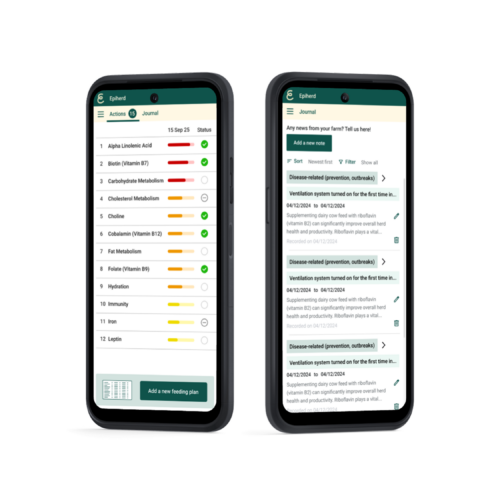
Antler Bio has evolved from an early-stage biotechnology start-up into a revenue-generating agri-tech business with commercial customers across Europe. Continued investment and successive collaborative projects have positioned the company to expand both its product portfolio and international reach.
EpiHerd gives dairy farmers access to a new layer of information about their animals, enabling more informed decisions around nutrition, breeding, health and management. Early commercial results suggest farmers can increase milk yield by up to 22%, milk fat by up to 6% and milk protein by up to 5% within six months of adopting the technology. Additionally, farmers have also seen significant improvements to herd health, including reductions of somatic cell count and fewer incidences of ketosis and mastitis – all contributing to reduced costs of production and improved environmental impact.
Epigenomics introduces an entirely new approach to herd management by measuring how animals are responding to their environment rather than relying solely on inherited genetics. As the technology continues to develop, it has the potential to improve productivity, reduce waste, strengthen animal welfare and support a more resilient dairy sector both in the UK and internationally.
What’s next?
With EpiHerd now commercially available, Antler Bio is focused on expanding adoption across the UK while continuing to strengthen the science behind the platform.
Current projects are adding new capabilities that will help farmers improve milk quality, optimise calf development and generate even greater value from epigenomic data throughout an animal’s lifetime. Longer term, the company plans to extend its technology into other livestock species and new customer markets including feed companies, veterinarians and animal health businesses.
Working with the UK Agri-Tech Centre has positioned Antler Bio to continue turning cutting-edge science into practical tools that help dairy farmers improve productivity, profitability and resilience while supporting a more sustainable future for livestock farming.