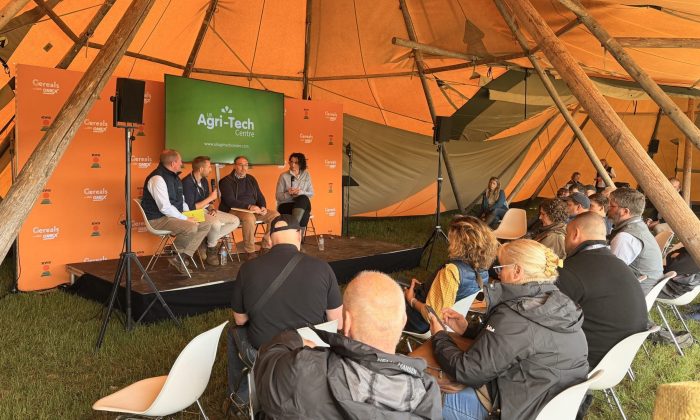

On day two of our UK Agri-Tech Centre Growth Week, we heard from Charlie Guy, CEO and founder of LettUs Grow, and Charlie Mercer, Policy Director at the Startup Coalition, about what it takes to scale agri-tech businesses in the UK. Together, they unpacked the realities of scaling deep-tech in agriculture: proving technology commercially, navigating funding challenges and making the UK a place where agri-tech businesses choose to stay and grow.
Why proving technology in agriculture takes longer than other sectors
“For Lettus Grow, the journey from ‘this works’ to ‘growers will invest in this’ took years of rigorous validation.”
Growers investing millions need scientific proof and economic validation, and agriculture’s seasonality means that proof takes time. Charlie Guy explained how LettUs Grow used controlled environments to accelerate R&D testing, then partnered with research institutions in the Netherlands and UK to build the academic credibility required before commercial growers would commit.
The lesson: In agri-tech, scientific proof and commercial proof must happen in parallel.
The UK policy landscape
Charlie Mercer was clear: the UK has built strong foundations for entrepreneurship over two decades: “We are the third biggest startup ecosystem in the world, and that doesn’t happen by accident. Over the last 20 years, we have seen successive governments of different stripes actually lay the foundations for entrepreneurs to succeed in the UK.”
Tax incentives like SEIS (Seed Enterprise Investment Scheme) and EIS (Enterprise Investment Scheme) have been crucial in attracting early-stage investment, particularly into high-risk, IP-intensive businesses like LettUs Grow.
However, as the ecosystem has matured toward hardware-intensive, deep-tech businesses, different policy levers are needed. While agri-tech has been identified as a frontier industry, implementation has been patchy.
Obstacles and catalysts for agri-tech businesses
Funding
LettUs Grow’s journey has coincided with the boom and bust of vertical farming investment. Schemes like SEIS have been vital in encouraging investment into high-risk, early-stage businesses. Different approaches may be needed for different types of technology.
Regulation and standards
For growers, UK regulation around product differentiation is limited. Charlie Guy explained the challenge: “In the UK, you’re either organic or you’re not. If you’re producing a better crop using methods that aren’t organic but using other methods that don’t fit in the organic bucket but are good in terms of water usage, no pesticides, grown locally, all these other very positive things — from a standards perspective, there’s no real way of differentiating by price when you’re growing a better quality product or a more sustainable product.”
This limits the commercial case for growers to invest in innovative growing methods that deliver sustainability and quality benefits but don’t fit within existing certification frameworks.
Energy and infrastructure
Charlie Guy commented on the impact energy policy could have: “You cannot underestimate the impact that being on the right side of that policy would have for our customers—to be able to do things that are more innovative, to invest in expansion, to improve how they’re doing things and in many ways make their businesses financially sustainable.”
New funding mechanisms like the Local Innovation Partnerships fund (£500 million through UKRI) offer potential to support sector-based innovation at a regional level, but leveraging these opportunities requires coordination between businesses, farmers and policymakers.
Talent and market size
The relatively small size of the UK’s protected cropping sector means that many of the large-scale project firms LettUs Grow partners with are based overseas, particularly in the Netherlands and North America. For technology businesses in UK agri-tech, a global outlook isn’t optional. To achieve venture-scale returns, international markets are essential.
Practical pathways forward
Both Charlies were optimistic about what’s possible through better coordination and targeted interventions:
- Expand trials for autonomous drones and robotics in farming to support farmer-driven innovation
- Scale programmes like ADOPT to enable farmers to move from testing to implementing proven innovations
- Reform energy pricing to support co-location of food production with renewables
- Update industrial classification codes so agri-tech businesses aren’t excluded from support schemes
- Create regulatory pathways for product differentiation beyond organic certification
- Join up food and energy policy — greenhouses using renewable energy support grid stability and decarbonisation
- Support circular, co-located systems integrating renewables, food, waste, heat and water treatment
- Invest in regional innovation ecosystems through funds like Local Innovation Partnerships
Key advice for agri-tech founders
Charlie Guy’s advice to other founders was grounded in lived experience:
- Stay optimistic but find your people “Optimism is definitely hard sometimes to keep. A lot of that optimism comes through meeting other people that you can bounce off and grow that optimism together. Make sure you can push above the noise and the things that are often trying to beat the optimism down around you. That connection with others that share your ambition and share your vision is important. Because that keeps you, when times are harder, focused on really having that impact at scale.”
- Prove it academically and commercially – In agri-tech, both matter. Build the validation step into your scale-up strategy.
- Think globally from day one – If you’re building agri-tech in the UK, you’ll need international customers to achieve venture-scale returns.
- Engage with policy – Charlie Mercer’s message was encouraging: “Policy is plastic. So long as you have evidence, you have a good narrative and you have folks who authentically speak to why it’s a good thing to change a policy, it can be done. It’s hard. It requires really staying the course.”
How the UK Agri-Tech Centre supports scaling businesses
We work with businesses like LettUs Grow at every stage of their journey:
- Validation and proof: Real-world testbeds and research partnerships to build scientific and commercial credibility
- Farmer networks: Connecting businesses with end-users to shape market fit and accelerate adoption
- International connections: Supporting global expansion through partnerships and market intelligence
- Policy engagement: Amplifying sector voices and working with coalitions to shape better policy outcomes
- Funding and support pathways: Navigating innovation funding, from ADOPT trials to UKRI programmes. Programmes like FASTA and our Agri-Tech Solution Sprints help SMEs move from technical challenge to commercial opportunity
Listen to the full podcast here.
If you’re building agri-tech and navigating the challenges of scaling, we’d love to support you. Get in touch today at [email protected]