
On International Day of Women and Girls in Science 2025, the UK Agri-Tech Centre is celebrating the contributions of women at our company. Dr. Phoebe Sutton, Innovation Sector lead is a plant scientist with a passion for applied research.
Discovering a passion for plant science
Growing up in Leicester, Phoebe didn’t come from a farming background. Her mother worked as a council secretary and her father was in the building trade. But she excelled in academia, particularly in biology, which she pursued at the University of Bristol. Initially uncertain about her specialism, it was during her undergraduate studies that she discovered a fascination with molecular plant science.
“I liked the simplicity of it,” she explains.
“Plants just respond to their environment using their genetic programming. There’s no messy behaviour like with animals, and the ethics of experiments are far easier to navigate so its easier to answer deeper questions.”
Her curiosity led her to an integrated master’s degree, before which she undertook a summer research project in partnership with a local vertical farming company. This experience inspired Phoebe and established an interest in how technology can enhance plant growth and nutrition, setting the foundation for her PhD research.
Navigating a PhD
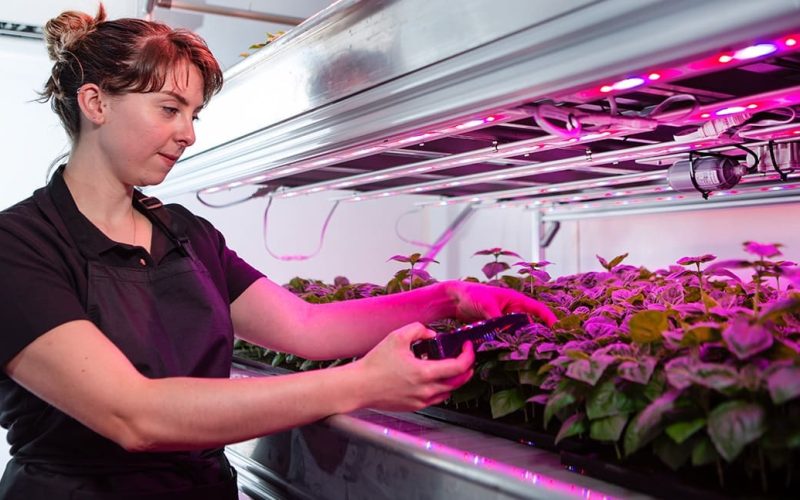
Phoebe’s PhD at Lancaster University focused on the effects of light on vertically grown plants, particularly how different wavelengths impact the nutritional density of leafy greens. Sponsored by an industry partner, she was conducting high level research at the intersection of academia and applied science.
But, like many researchers, Phoebe faced significant hurdles. In her first year, she constructed a bespoke vertical growth system with tuneable lighting inside a growth chamber, but at a critical point in her research, the environmental control of the plant growth chamber broke down, delaying her experiments for over a year. When it was finally repaired in early 2020, the pandemic hit, forcing her to pivot towards bioinformatics on published datasets.
“It was tough, especially since I’d been waiting so long to do the practical research,” she says. “But you have to keep looking for opportunities in setbacks. The data analysis added another element to my thesis and the time enabled me to do a desk-based review with one of the UK Agri-Tech Centre legacy centres, which sowed the seed for me joining in my current role.”
Despite the challenges, Phoebe successfully completed her PhD, even working unpaid for a period to finish her experiments. “It was a labour of love,” she admits, “but it’s also my greatest achievement.”
Breaking into industry
Towards the end of her PhD, Phoebe was approached by a horticultural lighting company, Vertically Urban, looking for a plant scientist to support their product development. This transition from academia to industry was a natural fit, allowing her to apply her expertise to real-world agricultural challenges.
At Vertically Urban, she balanced scientific research with elements of engineering and design, as well as marketing and sales — this SME experience deepened her understanding of innovation in the agri-tech sector.
Today, Phoebe works at the UK Agri-Tech Centre, where she plays a key role in research projects that bridge science and industry.
“I love the variety,” she says. “One day I’m analysing data, the next I’m attending conferences and the next I’m working with companies to design funding proposals. I greatly value the opportunity to work with people that have really exciting ideas about technology and how to improve food production in a range of different ways. It’s a much broader view of agriculture than I had in my PhD.”
The power of female mentorship
Reflecting on her career, Phoebe credits her success to strong female mentors.
“My PhD supervisor, Gabriella, was a huge champion for me—always putting my name forward for opportunities,” she says. “I was also lucky to work with inspiring women like Kerry Franklin, who supervised my research project at Bristol and was then my external examiner for my PhD. Its was a lovely circularity to my journey.”
While plant science has a relatively high proportion of women, Phoebe noticed a stark contrast when she moved into the business world.
“At Vertically Urban, I was often the only woman in the room,” she recalls. “That was a new experience, and there were challenges, but I never doubted my right to be there.”
Phoebe’s advice for young women in STEM is simple but powerful:
“Find the people who will lift you up. Seek out mentors, ask for guidance and surround yourself with those who champion your success. And above all, trust in your own abilities. If you’ve put in the work, you deserve to be there.”
Looking to the future
Phoebe sees broader changes on the horizon for agriculture.
“There’s a real shift happening,” she notes. “The old model of extracting from the land is being replaced by a more balanced approach—one that values sustainability, regeneration and working in harmony with nature.”
Women, she believes, will play a vital role in this transformation. “Whether it’s in regenerative farming or agri-tech, there’s a growing space for women to lead and shape the future of food production.”
Happy International Day of Women and Girls in Science!
If you want to learn more about Dr. Phoebe Sutton and her experience, get in touch via [email protected]