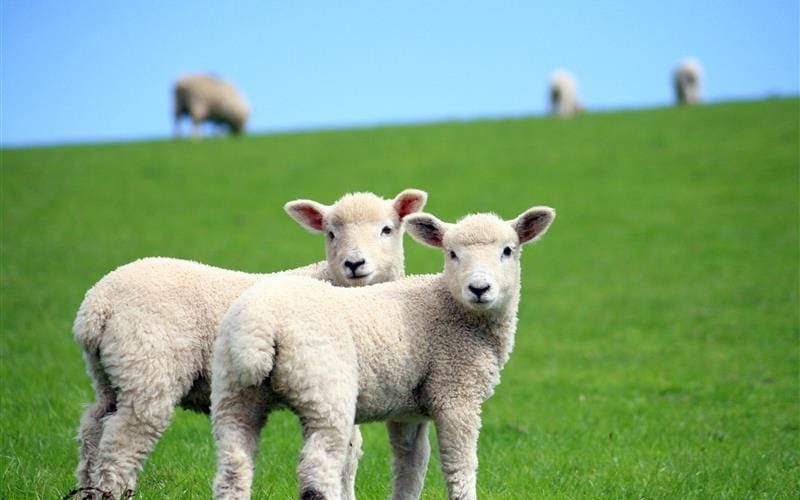

Weighing lambs is essential for tracking growth and deciding when they’re ready for market, but it’s also one of the most time-consuming and labour-intensive parts of sheep farming. Gathering the flock, running them through the scales and recording the data can take hours, often done every couple of weeks.
That’s why the ‘Lamb Monitor’ project is rethinking how weighing is done. Developed in collaboration with David Ritchie Agricultural (Implements) Ltd and the UK Agri-Tech Centre, supported by the National Sheep Association and with support from Defra and the Transforming Food Production (TFP) Challenge Programme (through Innovate UK), the project is putting automation, sensors and smart data systems to work to make lamb weighing simpler and less stressful for both farmers and animals.
Automation making a difference for livestock farmers
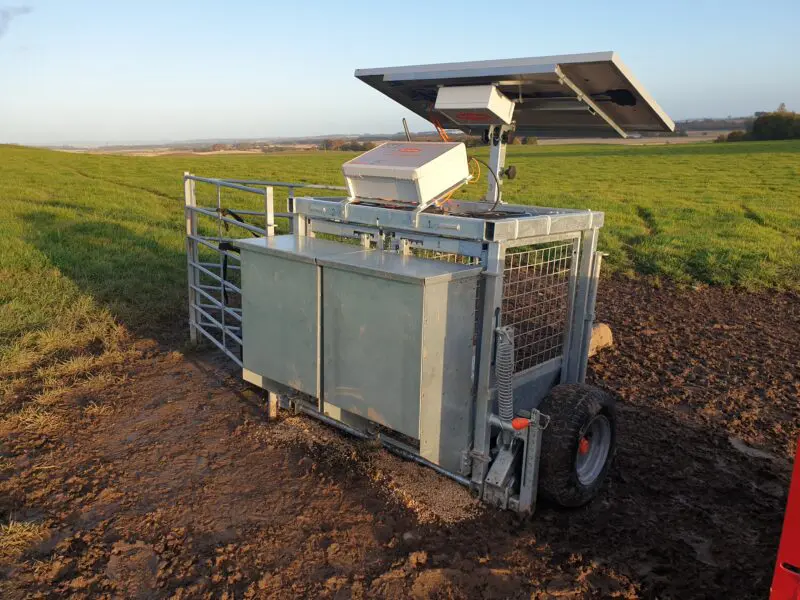
The Lamb Monitor is an automated, in-field solution designed to continuously monitor lamb performance without the need for regular manual weighing.
Three prototype designs are being tested:
- A walk-over weigher that records weights as lambs move naturally through it
- A creep-feed attractant to encourage voluntary weighing
- A climb-on platform that uses lambs’ play behaviour to capture data
- A metered feed creep for a small amount of feed stuffs as an attractant (minerals could be used)
Each system is paired with an easy-to-use app that gives farmers real-time insights into growth rates and weight gain. The system also includes a metered creep-feed setup, which ensures fair feed distribution among lambs and reduces the risk of overfeeding. This system results in better data, less stress and more efficient management, all without disrupting the daily routine.
Test trial and demonstrate
The Lamb Monitor prototypes are currently being deployed on Ritchie’s trial farms and will be on four UK Agri-Tech Centre innovation farms. Farmers continue their usual weighing practices alongside the automated systems, giving researchers the opportunity to compare data accuracy and gather farmer feedback to refine the technology.
Importantly, the automated system also integrates with Ritchie’s auto-drafting equipment, meaning lambs can be automatically sorted once weight data reaches the desired threshold, saving even more time and labour.
Charlie Brown, Product Development Manager at Ritchie, said: “We aim to bring a level of automation and improved efficiency to the sheep industry with this product. The first prototype was created after farmer-led interactions resulted in us making efficiencies within the industry. Following field trials and farmer feedback, we’re refining the product for our Mk2 trial.”
This hands-on, collaborative approach ensures that the final product will be practical, reliable and built around farmers’ needs.
From research to real-world application
The UK Agri-Tech Centre has played a key role in bringing the project from concept to on-farm testing, helping Ritchie navigate the development process, manage trials across multiple farms and gather real-world validation.
Hayley Gerry, Project Manager at the UK Agri-Tech Centre, explained: “This project has enabled us to bridge a gap the industry itself identified, where efficiencies could be made. By using our farmer network, we can test and validate the prototypes in commercial setups and feed that insight back into product development. This helps Ritchie move towards commercialisation with confidence.”
By supporting testing and integration directly on working farms, the UK Agri-Tech Centre ensures new technologies can fit seamlessly into existing operations and deliver tangible benefits from day one.
Improving livestock production for the sector
The benefits of automated lamb monitoring go well beyond saving time. Reducing handling and gathering means less stress for animals, resulting in higher-welfare products. At the same time, better data allows farmers to make more precise management decisions, optimising feeding, improving growth rates and reducing time to market. This also supports sustainability targets. Research from CIEL (2020) showed that improved data capture can cut greenhouse gas emissions in lamb production by up to 68% on hill farms and 37% on lowland farms.
With further studies showing that precision livestock technologies can save up to 36% in labour costs (Morgan-Davis et al., 2018), automation is becoming a vital part of building a more efficient, sustainable and resilient sheep sector.
The Lamb Monitor project is a clear example of how collaboration between technology developers and farmers can transform traditional practices. By combining advanced sensors, automation and data-driven insight, the project is showing what’s possible when innovation is tested and proven in real farming conditions, along with feedback from farmers for co-development.
As the technology continues to evolve, it has the potential to reshape lamb production across the UK, improving welfare, cutting emissions and giving farmers more control over their operations.