
By Ruth Bastow, Chief Technology and Innovation Officer at the UK Agri-Tech Centre.
The UK has no shortage of agri-tech innovation.
At the UK Agri-Tech Center we have the pleasure of interacting and working with businesses developing exciting new technologies for horticulture—from robotics and AI to precision sensing and biological solutions. The creativity, ambition and technical expertise across our sector are remarkable.
But innovation itself isn’t our biggest challenge.
The real challenge is turning promising ideas into technologies that growers trust, adopt and benefit from on commercial farms and businesses
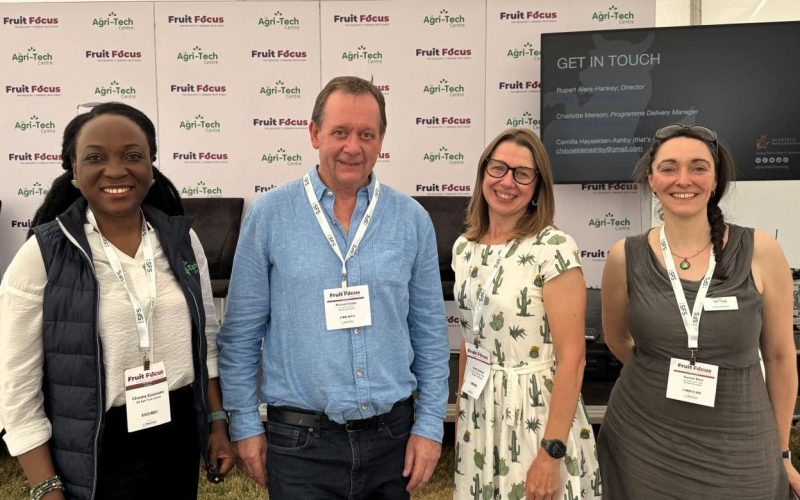
That was the message I wanted to share at Fruit Focus.
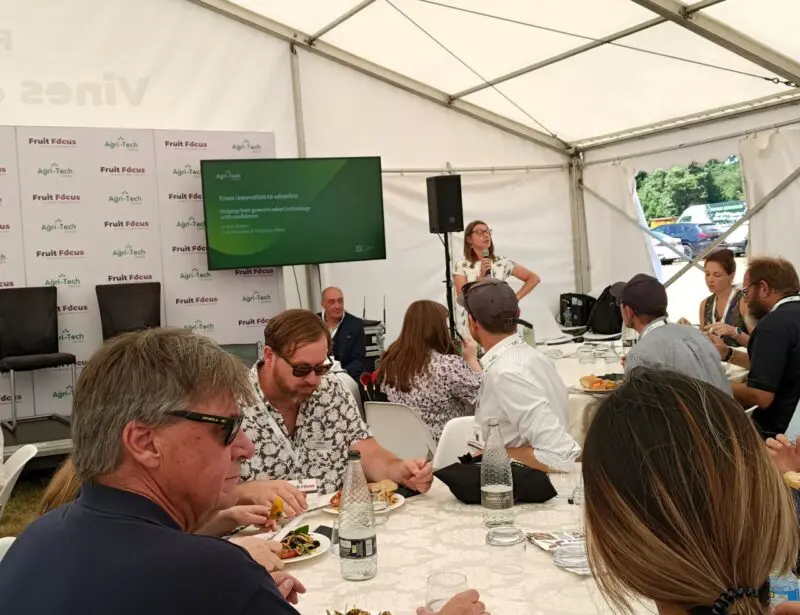
Fruit growers are operating under increasing pressure. Labour shortages remain a significant concern, production costs continue to rise, weather is becoming less predictable, and growers are expected to produce high-quality crops more sustainably than ever before.
Technology can help address many of these challenges but only if it solves a genuine problem.
Growers quite rightly want evidence before investing. They need confidence that a new technology will work reliably in commercial conditions and deliver measurable value for their business.
That’s where the UK Agri-Tech Centre comes in.
Our role is to help businesses move from innovation to adoption. We work alongside technology developers, growers and industry partners to prove solutions through commercial trials, build stronger businesses through technical and commercial support, and ultimately help successful innovations scale across the sector.
Our mission is simple: prove solutions, build businesses and scale impact.
Across horticulture we’re already seeing what this looks like in practice.
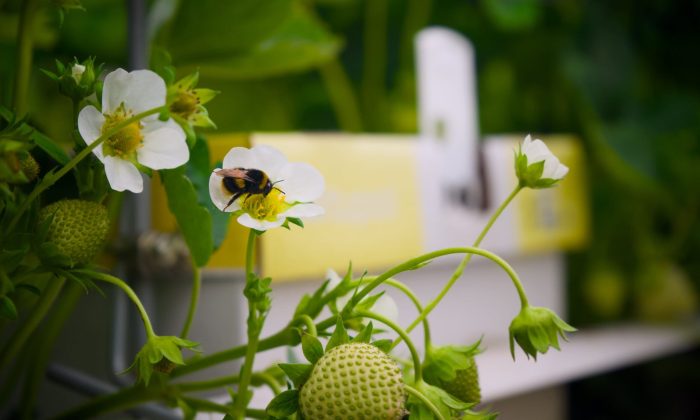
Projects such as Polybee are exploring how autonomous drones can improve pollination in protected strawberries while generating valuable crop data. FROST is helping vineyard managers make more informed decisions about frost protection through site-specific forecasting. FLEXBOT is developing adaptable robotic platforms to help address labour shortages, while SporeDetect is validating technology that enables growers to make more targeted disease management decisions using real-time pathogen detection.
Although the technologies are very different, they all follow the same journey. Following on from an idea or concept a prototype is generated that can be tested under commercial conditions, refined through collaboration with growers and commercial partner and independently validated before being taken to market.
That process is just as important as the innovation itself.
We’re also seeing more opportunities for growers to lead innovation directly. Through the ADOPT Fund, supported by Defra and Innovate UK, farmers and growers can secure funding to trial practical ideas on their own businesses, backed by expert support throughout the process. This helps generate the evidence needed for wider adoption while ensuring innovation is grounded in real farming challenges.
Ultimately, successful innovation isn’t measured by the number of technologies we develop.
It’s measured by the number that growers choose to adopt because they know they work.
If we want the UK to remain a global leader in agri-tech, we need to continue building confidence – confidence for growers, technology businesses, investors and policymakers alike.
At the UK Agri-Tech Centre, that’s exactly what we’re here to do: helping innovative ideas become practical solutions that deliver real impact for UK horticulture.