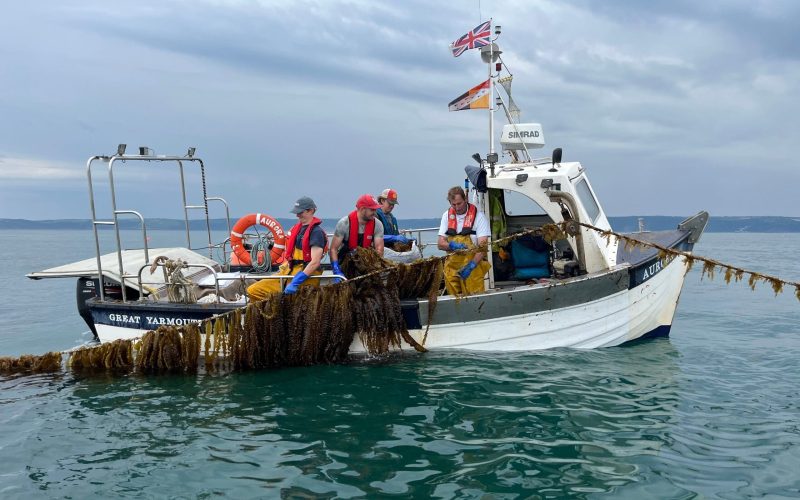

A groundbreaking project exploring low‑energy methods for processing cultivated kelp into a liquid biostimulant and animal feed supplement has exceeded early field‑test expectations and taken a significant step toward commercialisation.
Backed by Innovate UK, the nation’s innovation agency, the ‘Optimising low energy extraction of kelp for soil and livestock nutrition‘ initiative (Low Energy Kelp) advances earlier feasibility research. The work centres on refining liquid extraction and ensiling techniques for kelp, to establish a two-stage extraction process that yields reliable agricultural products.
The project brings together Algapelago Marine Limited, a farming-led seaweed biotech enterprise with an offshore cultivation operation, as lead partner, alongside Rothamsted Research and the UK Agri-Tech Centre. Together, they have validated product performance under challenging abiotic stress scenarios.
Growing demand for seaweed biostimulants
Agricultural interest in biostimulants derived from seaweed continues to expand, driven by their capacity to boost crop development, strengthen stress resilience and improve nutrient utilisation efficiency. Their sustainable sourcing also offers positive environmental advantages.
The agri-seaweed market currently relies heavily on wild-harvested material, though demand for seaweed-based agricultural supplements is projected to surge as regulatory frameworks push for reduced chemical inputs.
Initial testing
Testing took place within Rothamsted’s controlled environment infrastructure, enabling the research team to determine ideal application methods and dosing for Algapelago’s prototype formula.
The initial phase examined how four different foliar application rates affected wheat and field bean productivity under both adequate irrigation and drought stress. A second phase compared the effectiveness of foliar versus soil application on wheat yields. Additional testing to assess application timing relative to plant development stages and performance under varied drought conditions has been recommended to further refine the biostimulant’s use. Trials using different fertiliser levels were also suggested, as the product may demonstrate enhanced benefits under more nutrient-constrained scenarios than those examined in this study.
Tangible yield improvements
The research confirms that under specific circumstances, seaweed-derived biostimulants deliver tangible crop yield improvements. Dr Marieme Drame, Scientific Technician at Rothamsted Research, North Wyke, expressed enthusiasm about the findings.
She said: “Kelp-derived biostimulants offer a systems-based solution that works with plant and soil biology to enhance crop performance. At the optimal application rate in our wheat trials, we observed improved growth and yield, along with positive indirect effects on soil microbial activity, demonstrating clear value for productive and resilient farming systems.”
The importance of collaboration
Dr Hari Ram Upadhayay, Scientist in Agroecosystem Biogeochemistry at Rothamsted Research, North Wyke, emphasised the importance of partnership. He said: “Collaboration is a key to driving innovation. Here, kelp-derived biostimulants innovation holds major promise for supporting sustainable intensification as agriculture adapts to a changing climate.”
Professor Adie Collins, Science Director at Rothamsted Research, highlighted how industry-science partnerships can advance the sector. He said: “This project provides a good example of how industry and science teams can co-work together to ensure robust evidence is assembled on potential new interventions in support of sustainable and resilient agriculture in a changing and challenging world.”
Industry insights and grower engagement
Dr Saravanan Rengaraj, Innovation Associate for Soil Health at the UK Agri-Tech Centre, said: “Algapelago has successfully applied nature based farmed seaweed chemistry through a scalable biostimulant platform designed to enhance crop yield stability and nutrient use efficiency. We at the UK Agri-Tech Centre feel proud to have supported with technical validation and project management.”
Kerr Jeferies, Market Research & Partnerships Manager at Algapelago, said: “The insights from our direct engagement with growers have been invaluable. Hearing directly from leading farm managers and agronomists has sharpened our focus and made us even more confident in the product’s potential and market fit. We’re excited to continue engaging with these partners as we go from prototype to full commercialisation of the UK cultivated kelp biostimulant.”
What’s next?
Speaking about the project and the progress it has made in exceeding its targets, Luke Ansell, Head of Operations & Research at Algapelago, said: “The Low Energy Kelp project set out an ambitious goal to unlock the supply of cultivated kelp as a quality agricultural supplement.
Over the last two years, we’ve made great progress towards that goal, moving from concept phase to a low-energy processing method stress-tested at a 1-tonne scale. The prototype biostimulant product has far exceeded expectations in wheat trials, demonstrating that biostimulants sourced from cultivated seaweed can outperform market incumbents.
Though the Low Energy Kelp project has ended, we will continue to build the evidence base for product efficacy and move towards commercial production through the sister Innovate UK SKE-NMT project. I want to thank all project partners, including Atlantic Mariculture, Rothamsted Research and the UK Agri-Tech Centre, for their contributions. It’s been a pleasure working with the consortium team and we look forward to providing more updates on our work soon.”