
It’s not often ADOPT gets a shout-out from the opening speaker at an international conference. But that’s exactly what happened when Professor Daniel Berckmans highlighted the programme as an example of turning science into practical action on farm.
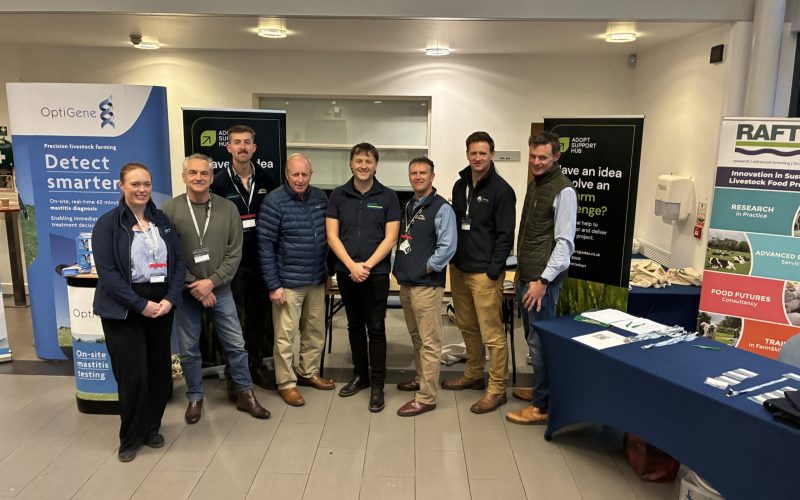
His message set the tone for yesterday’s RAFT Solutions Precision Livestock Farming Conference, at Harper Adams University, bringing together farmers, researchers and technology developers around one clear challenge: how do we ensure innovation delivers what farmers actually need?
It’s a challenge we see across agri-tech. Developing technology is only part of the job. Adoption depends on whether it solves a problem that matters, works in the realities of farming and gives people the evidence and confidence to use it.
From science to action
Opening the conference, Professor Berckmans, from KU Leuven in Belgium and the University of Tennessee in the USA, explored the progress and future direction of precision livestock farming.
His message was clear. Scientists and developers need to listen to farmers, who understand the animals, processes and practical realities of farming. Ultimately, farmers will determine whether technology succeeds.
Technology must also demonstrate a return on investment and translate scientific advances into practical solutions.
Professor Berckmans highlighted ADOPT as a great example of this approach, bringing farmers and researchers together to turn science into action.
More data isn’t always better
Professor Tomas Norton, also from KU Leuven, questioned not just what technology measures, but how that information is interpreted and used.
Too often, development starts with what is technically possible rather than what farmers need. Engagement with farmers remains a missing piece.
Precision livestock technologies can generate enormous volumes of data, but farmers need quality information that supports decisions, not more dashboards and alerts.
He challenged developers to ask two questions:
- What decision will this data change?
- Who will act on it?
If data doesn’t help someone make a better decision, improve performance or save time, what value is it adding?
It’s an important reminder that adoption isn’t driven by how much a technology can do. It’s driven by whether it helps solve a real problem and makes a meaningful difference to the farming business.
Let the farmer be the farmer
David Speller from OPTIfarm shared his journey, which began, as he put it, “as a farmer with a problem.”
He was losing money because he was identifying problems too late. Technology offered a way to spot issues earlier and act before they affected performance.
But his message went beyond financial returns. Technology shouldn’t make busy people busier. Ideally, it should let farmers spend more time farming.
Adoption isn’t just about cost. Technology must make life easier, reduce pressure and give farmers greater peace of mind.
Technology has to earn its place
David Craven from Grosvenor Farms shared how he continually evaluates technology to ensure it delivers what his business needs.
He also emphasised the importance of training, giving staff the confidence to turn information into action.
As David observed, “the younger generation are hungry for technology.” Harnessing that enthusiasm means ensuring people have the skills and support to use it effectively.
Delegates also visited three interactive farm stations, exploring precision livestock technologies and their practical applications.
ADOPT: Putting farmers at the centre
The conference’s messages reflected the principles behind ADOPT, part of Defra’s Farming Innovation Programme, delivered by Innovate UK.
ADOPT puts farmers, growers and foresters at the heart of innovation, supporting them to lead trials that tackle real challenges.
Through the ADOPT Support Hub, the UK Agri-Tech Centre and its partners connect farmers with the expertise and support to turn ideas into practical solutions.
Raising agri-tech’s profile across government
Chris Lyons from Innovate UK reinforced these messages during the panel discussion, highlighting the need to move agri-tech higher up the government’s agenda.
He stressed the importance of engaging departments beyond Defra, including Business and Trade, Education and the Treasury, recognising agri-tech’s contribution to skills, investment and economic growth.
Chris also highlighted ADOPT’s success in bringing farmers closer to researchers and encouraging farmer-to-farmer learning, helping get technology onto farms.
A particular strength is the diversity of participating businesses, from small county council farms to Dyson Farming, across different systems, scales and geographical locations.
This helps ensure innovation is tested in real farming conditions and solutions are relevant to businesses of all sizes.
Turning innovation into adoption
The message from the conference was clear. Precision livestock technology has enormous potential, but success depends on solving real farming challenges, demonstrating value and giving farmers confidence to adopt it.
For us, the takeaway is simple: adoption can’t be treated as the final stage of technology development. It needs to shape development from the start.
That distinction matters. The value of technology isn’t in the amount of data it produces, but in what a farmer can do differently as a result.
That’s where the UK Agri-Tech Centre comes in. We bring businesses, farmers, researchers and partners together to help promising technologies prove their value, build confidence and move towards wider adoption.
Through programmes such as ADOPT, we’re helping turn research into action and technology into real benefits for farming businesses.
Because the real measure of innovation isn’t what technology can do, but the difference it makes on farm.
Find out more about ADOPT and the support avaliable to farmers.