
An innovative project, Precision Pollination for Higher Strawberry Productivity and Quality, is harnessing robotics and AI to transform how strawberries are grown in the UK. At the centre of this work is a collaboration between the UK Agri-Tech Centre, Angus Soft Fruits and Singapore-based technology company Polybee, with funding support from Innovate UK and Singapore funder, Enterprise Singapore.
Polybee’s autonomous drone technology, designed to use airflow to aid pollen transfer, is one of the first of its kind to be deployed in the UK. Bringing advanced robotics into commercial farming environments, however, has its challenges, particularly when introducing drones into the daily operations of growers. The UK Agri-Tech Centre has helped to address these challenges.
Sarthak Mittal, Lead Product Engineer at Polybee, said: “The UK Agri-Tech Centre team has helped us deploy our technology on farms across the UK. They’ve been on-site with me, helping figure out where to deploy the drones, how to keep them away from daily farm operations, and ensuring safety in all our activities. All of this is new for us at Polybee, and it’s one of our first deployments in the UK. It has been great having them on-site to help us navigate the process.”
How robotics and AI are supporting pollination
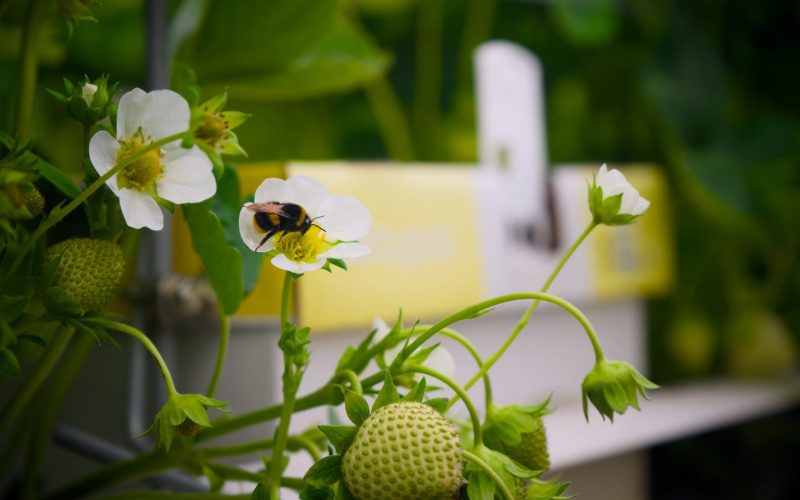
Most UK strawberries are grown in polytunnels or glasshouses, where natural pollination is difficult to achieve at scale. While bumblebees and honeybees are often relied upon, their activity can be limited by weather, temperature or crop growth stage, leading to inconsistent results.
Polybee’s drone-based solution applies robotics and AI to this challenge. By using controlled airflow, the drones help distribute pollen more evenly across plants, reducing the risk of misshapen or undersized fruit and boosting the proportion of “Class 1” strawberries, the highest retail grade.
But deploying AI-driven drones into working farms is not simply a matter of switching them on. Safe integration, alignment with farm routines and adapting to growers’ needs are essential for success. The UK Agri-Tech Centre has played a central role in making that transition possible.
Test, trial and demonstrate
The UK Agri-Tech Centre team has supported the project from assessing where and when to deploy drones to managing safety considerations in active farm environments, ensuring that Polybee’s robotic pollinators could be tested and refined in real-world conditions.
Katie Clark, Project Manager at the UK Agri-Tech Centre, highlighted the importance of this collaborative approach: “This project represents a critical step towards leveraging innovative drone technology to enhance strawberry yield and fruit quality, addressing the challenges of pollination in protected growing environments. By combining cutting-edge drone solutions with the knowledge of leading growers and agri-tech specialists, we aim to drive meaningful advancements in food security and sustainability for the UK and beyond.”
With Angus Soft Fruits providing commercial testing environments, Polybee delivering robotics and AI expertise and the UK Agri-Tech Centre supporting deployment and grower integration, the project represents a model for how innovation can be scaled into agriculture.
Lucy Wilkins, Breeding Programme Director at Angus Soft Fruits, said: “Enhancing pollination by integrating advanced technology alongside bumblebees promises significant benefits for our growers, ultimately improving yields of Class 1 and premium-tier strawberries.”
This fusion of technology, grower insight and hands-on support is paving the way to grow more resilient and productive food systems for the sector.
Driving food security through robotics and AI
The Precision Pollination project showcases how the UK Agri-Tech Centre supports robotics and AI businesses along with the UK soft fruit industry, in adapting their solutions to grow the agricultural sector, helping them work alongside growers to test and trial their products and deliver sustainable food security outcomes.