

Labour shortages, rising costs and tight margins are ongoing challenges for UK soft fruit growers.
But what if agri-tech automation could help ease this pressure without requiring an overhaul of operations?
A new collaborative project, FLEXBOT, is exploring how flexible, scalable agricultural robotics can support soft fruit farmers to improve productivity, profitability and resilience.
What is FLEXBOT?
The FLEXBOT project (‘Building a [Fl]exible, [Ex]tensible Co[bo]t Pla[t]form for Farmers’) is led by Antobot, alongside the University of Surrey, Dogtooth Technologies Ltd and the UK Agri-Tech Centre, funded by Innovate UK.
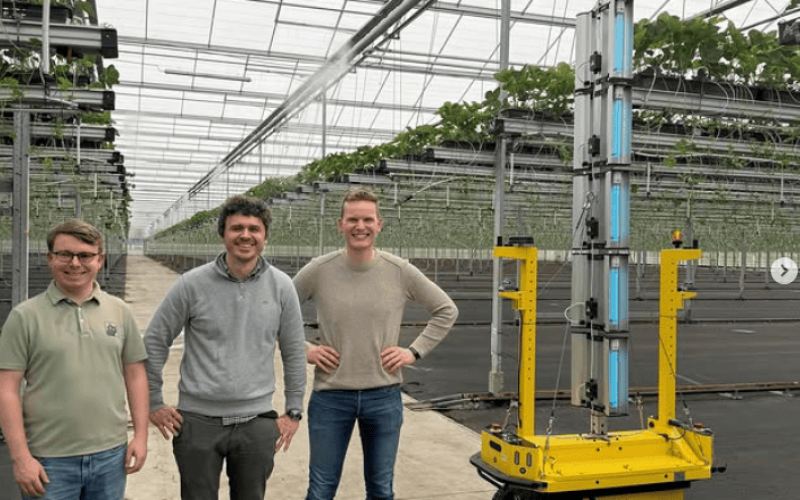
Together the consortium is developing a new generation of collaborative robots (or “cobots”) designed for farm logistics.
The project focuses on integrating autonomous systems into real-farm environments, with a strong emphasis on practical, commercially viable solutions for growers.
It also aims to address fragmentation between technology providers and end users — helping move towards more joined-up, scalable systems.
What the project will deliver 
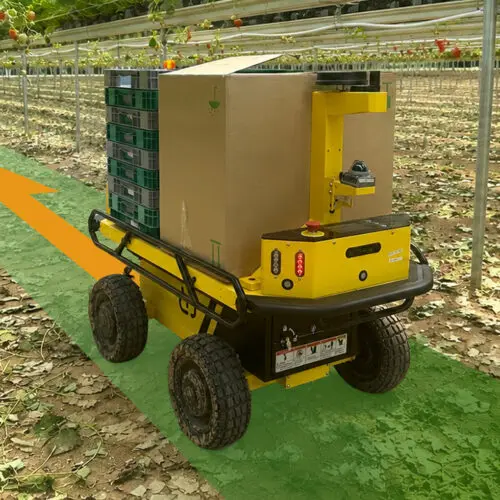
FLEXBOT will demonstrate how cobots can support soft fruit production through:
- Demonstrating the feasibility of supply chain interoperability between suppliers
- Exploring a sustainable business model for small to medium-sized fruit and crop farmers
- Establishing an autonomous fruit-farming cobot undertaking various logistics tasks
What are the benefits?
The FLEXBOT project will present farmers with the opportunity to:
- Increase productivity through more efficient allocation of expensive human labour (e.g harvesting)
- Improve crop quality, yields and profits throughout the supply chain by reducing the time between harvesting and cooling
- Reduce crop waste and replacing small fossil-fuel driven vehicles, reducing carbon output
- Adapt to future challenges through incremental investment in fleet and add-ons
- Strengthen resilience to social, economic and cultural change, achievable by phasing in automation, year-on-year, to reinvest profits to support an ever-leaner workforce
Alongside this, the project will explore add-on solutions, allowing growers to tailor automation to their specific production systems and budgets.
The role of the UK Agri-Tech Centre
As part of the project, the UK Agri-Tech Centre is helping ensure these robotic harvesting systems are developed with commercial viability, sustainability and real-world farm adoption in mind.
Working alongside consortium partners, the team is applying systems dynamics and sustainability modelling to explore:
- The operational and economic value these systems could deliver for grower
- Their environmental and social impacts across the production system
- The factors influencing adoption, scalability and long-term viability within UK horticulture
By combining technical, economic and sustainability perspectives, this work provides evidence to support decision-making throughout the development process, helping ensure the technology is not only technically capable, but practical, commercially relevant and aligned with the needs of UK farming businesses.
Deborah Whittaker, Sustainability Modelling Lead/Aditya Jadhav, Robotics Engineer at the UK Agri-Tech Centre, said:
“FLEXBOT is entering a new phase with an emphasis on quality engineering and an output of a strong product offering for growers.
Alongside two of the leading agricultural robotics developers in the UK today, the UK Agri-Tech Centre is ensuring that ensuring that these systems are designed from the outset to meet the needs of growers.
We are utilising our expertise in sustainability modelling to understand what the product needs to be to meet the commercial and environmental requirements the sector demands.”
Consortium perspectives
Marc Jones, Business Director at Antobot, said:
“Antobot is proud to be advancing the FLEXBOT project with support from Innovate UK funding, accelerating the development of next-generation logistics robots for fruit farms, at a time when growers face increasing pressure from labour shortages, rising costs and tight production margins.
This investment enables deeper collaboration with growers, researchers and technology partners to deliver practical automation that improves harvest efficiency, reduces labour pressure and helps protect crop quality through faster on-farm transport. “
Dr Duncan Robertson, Founder and CEO at Dogtooth Technologies Ltd., said:
“Safe, reliable navigation on outdoor farms remains a critical challenge for the horticultural industry. Through FLEXBOT, Dogtooth will develop new technologies that build on our existing systems, increasing confidence in the use of automation in this demanding environment.
Simon Hadfield, Professor of Robot Vision & Autonomous Systems at University of Surrey, said:
“CueBEV is a new AI technique that creates accurate overhead maps for agricultural robots by flexibly combining whatever visual cues or sensors are available… Its ability to pick out small or moving objects supports safer and more reliable automation in agriculture.”