
In March 2025, the UK Agri-Tech Centre worked alongside Bahrain’s Ministry of Municipalities Affairs and Agriculture (MoMAA) and the British Embassy Bahrain to support Bahrain’s Strategic Food Security objectives, while also creating a valuable international opportunity for UK agri-tech businesses ready to scale.
The project focused on identifying practical, high-impact technologies from the UK that could strengthen sustainable food production in Bahrain’s climate, and help local growers improve productivity, resilience and resource efficiency. At the same time, it gave participating UK companies a supported route into a new market, helping them build relationships, validate performance in real-world conditions and explore long-term commercial pathways across Bahrain and the wider Middle East.
Three UK agri-tech companies were selected to take part in the test and trial initiative: Polysolar, Ostara and Zayndu. Each business was given the opportunity to showcase its technology at MoMAA’s incubation site, creating a physical presence in Bahrain and enabling direct engagement with growers, ministry teams and key stakeholders across the sector.
Demonstrating UK innovation in real-world growing conditions
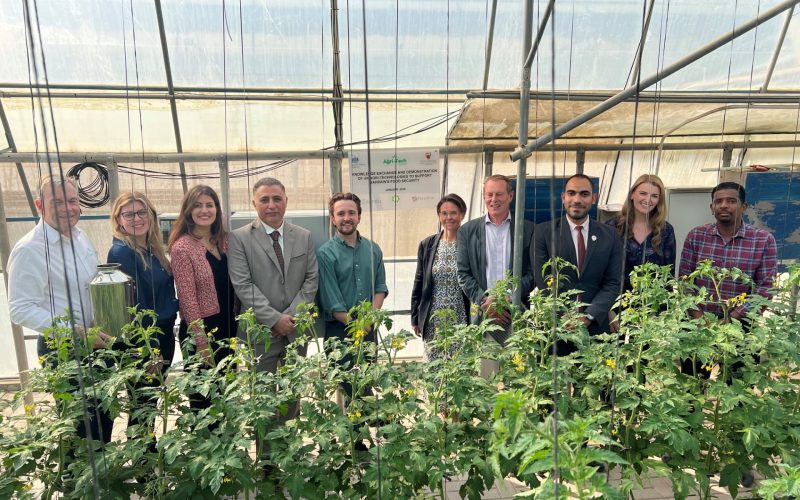
Demonstrations were designed to be hands-on and data-led. This included Polysolar’s solar technology that was installed across two sites—MoMAA’s incubation site and the Bahrain Agricultural Development Company site—to explore how lightweight, flexible solar PV could support horticultural production. The arrays were split between 8kW and 4kW and trialled with different panel densities (10–30% shading), allowing performance to be evaluated across different crops, including tomatoes and salads. The trials are generating valuable insights on how the technology performs in a different climate, helping inform product development and market readiness both in Bahrain and beyond.
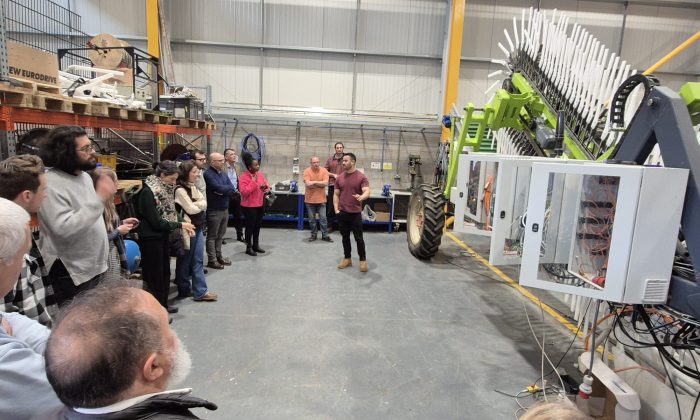
Alongside renewable energy generation, the programme also introduced Ostara’s advanced automation for protected growing environments. A network of sensors and control systems was installed in a greenhouse at the MoMAA incubation site, monitoring internal and external conditions and enabling control of roof vents, fans, cooling pumps, shade netting, irrigation and fertigation networks. Training was delivered directly to growers, giving them practical experience in setting environmental targets and using real-time data to manage crop conditions remotely. The inclusion of predictive control, using weather forecasts to take proactive action, offered additional value in managing extreme temperature fluctuations and high winds.
Seed performance and crop establishment were also a key focus. Zayndu’s cold plasma seed treatment technology was installed in a fully climate-controlled room at the incubation site, with hands-on training provided to MoMAA personnel. A range of seeds were treated and planted at the ministry site to demonstrate the impact of the technology and build local capability. In particular, the technology was trialled on Mimusops laurifolia seeds, well known for low germination. Results showed notable germination and reduced germination time compared to other treatments and control.
Creating momentum for international growth
Beyond the technology installations, the UK Agri-Tech Centre’s role was to help ensure the opportunity translated into long-term momentum for participating businesses. The programme enabled companies to meet stakeholders, understand regional needs first-hand and explore collaboration opportunities that could lead to future deployments, partnerships and investment conversations.
Since the visits, progress has continued: trials are ongoing, additional sales discussions have begun and wider regional opportunities, including in the UAE and Saudi Arabia, are being actively explored. Further work is also underway with local farmers to improve yields, alongside plans to support a Bahraini native seed bank and develop protocols for tree seed establishment across Bahrain.
The project also delivered knowledge exchange at multiple levels. Training was provided to ministry personnel to support adoption and confidence in the technologies, and an open day helped showcase the innovations to external stakeholders across the supply chain. As the project develops, its economic, societal and environmental impact will continue to be monitored closely with each company, supporting both Bahrain’s food security ambitions and the international growth of UK agri-tech innovation.
Get involved
By embedding UK ventures into local ecosystems, the UK Agri-Tech Centre removes barriers to investment and opens commercial pathways, helping UK ventures to compete and thrive globally.