
By Helen Brookes, Cereals panel host and Head of Agri Value Chain Engagement at the UK Agri-Tech Centre.
The arable sector is under increasing pressure.
From rising input costs to environmental demands and the need to maintain productivity, farmers are being asked to balance competing priorities in an uncertain landscape.
The conversation isn’t about what agri-tech could do.
It’s about what’s actually working in practice.
What’s shaping decisions on farm
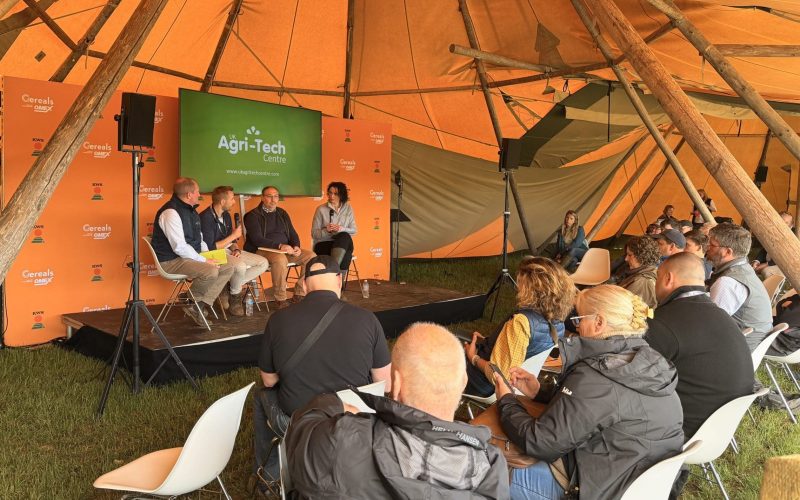
On the Cereals Seed to Shelf Stage yesterday, where I had the opportunity to host a panel discussion, conversations reflected a consistent reality…
Farmers are navigating:
- tighter margins and rising costs
- increasing scrutiny on environmental impact
- growing expectations around resilience and sustainability
These pressures are immediate and they’re shaping day-to-day decisions.
In that context, technology has a role to play, but only if it addresses real challenges in a practical way.
Where agri-tech needs to deliver
Across the discussion, one point came through clearly:
innovation alone isn’t enough.
What matters is whether solutions:
- help farmers make better decisions
- improve efficiency in how resources are used
- fit into existing farm systems without adding complexity
As one panelist highlighted, there is no shortage of agri-tech available. The challenge is identifying what genuinely delivers value.
The focus is shifting from what’s new to what’s useful.
What’s working in the field
Insights from agri-tech businesses working directly with farmers pointed to four clear themes.
1. Practicality wins
Solutions that integrate into existing operations are far more effective.
“You often hear about technology being developed away from the end user and it’s never as useful.”
— Rob Vanhoucke, Paul-Tech, Cereals panelist
Technologies that align with how farms already operate are more likely to deliver consistent value.
2. Value needs to be clear
The benefit of any technology needs to be visible.
Whether it’s cost savings, improved input efficiency or better decision-making, the return needs to be understood quickly.
As highlighted during the discussion, the key test remains simple:
“Are you actually solving a problem?”
— Dr Apostolos Papadopoulos, Crop Intellect and Cereals panellist
For Crop Intellect, this means ensuring that innovation delivers both practical value for farmers and measurable environmental outcomes, particularly where technologies need to support productivity while reducing agricultural emissions.
3. Farmers shape what works
Real-world testing and honest feedback are essential.
“Farmers can make or break a technology.”
— Dr Apostolos Papadopoulos
Trialling across different farms and conditions, and being open to what does and doesn’t work is what turns innovation into something usable.
4. Collaboration is critical
Delivering value increasingly depends on how technologies connect across the wider system.
From supply chains to finance and insurance, collaboration and data-sharing are becoming more important.
As Rob Vanhoucke explained:
“Industry is really interested in the data that this kind of tech can provide… and can help de-risk some of that adoption.”
What this looks like in practice
For agri-tech businesses, these principles are already shaping how solutions are developed and scaled.
At Paul-Tech, ongoing trials and farmer engagement are central to refining its technology, ensuring it delivers practical value in the field.
For Crop Intellect, bringing a new solution to market has required sustained investment in field testing, independent validation, farmer engagement and supply chain collaboration. This has been particularly important where new technologies need to demonstrate both practical agronomic value and measurable environmental impact.
In both cases, progress is driven not just by innovation, but by how that innovation performs in real-world conditions—supported by access to testing, validation and industry collaboration, an area where the UK Agri-Tech Centre works closely with businesses.
What this means
The UK is strong in agri-tech innovation.
The opportunity now is ensuring that innovation translates into solutions that work—reliably, practically and in real-world conditions.
Supporting the journey
For businesses such as Paul-Tech and Crop Intellect, progress has depended on rigorous testing, farmer engagement and collaboration, not innovation alone.
Moving from concept to real-world impact requires access to trial environments, independent validation, industry expertise and routes to market—areas where many businesses face challenges.
As Steve McLean explains:
“This is where businesses really need support—to move from innovation to real-world impact. That’s exactly where the UK Agri-Tech Centre fits in. Our role is to provide the independent advice, capabilities and connections that help businesses prove, build and scale their solutions in real-world conditions, rather than R&D.”
— Steve McLean, CEO of UK Agri-Tech Centre and Cereals panelist.
The UK has a strong foundation in agri-tech. The next step is ensuring that innovation delivers practical outcomes for farmers and creates value across the sector.