
A new report from the UK Agri-Tech Centre outlines a forward-looking vision for how the UK’s arable and horticultural industries can harness innovation to enhance resilience, productivity and environmental sustainability over the next decade.
Commissioned and authored by the UK Agri-Tech Centre, ‘The future of arable and horticulture innovation: Shaping the next 10 years’ projects toward 2035, identifying the technologies and innovation pathways most likely to accelerate growth in the UK’s agri-tech sector while delivering benefits across the wider food system.
The report stresses that UK agriculture stands at a pivotal moment. With mounting climate pressures, ongoing labour shortages and increasing input costs, the need for smart, efficient and integrated farming systems is greater than ever. From advanced sensing and AI to biotechnology and controlled-environment production, emerging technologies will be essential for tackling these challenges and unlocking new commercial opportunities for UK innovators.
Drawing on interviews and collaborative workshops across the supply chain and underpinned by the UK Agri-Tech Centre’s technical expertise, the report identifies three major themes shaping future innovation:
- Climate change mitigation
- Automation and digitisation
- Diversification of production
Dr Harry Langford, Innovation Director at the UK Agri-Tech Centre, said: “For agri-tech to realise its full potential, innovators need both clear pathways and the ability to connect bright ideas with the complexities of real-world farming. By linking research technology development and commercial practice, the sector can bridge the critical gaps between concept and adoption, delivering scalable, on-farm solutions.”
To set a forward agenda for innovation, the UK Agri-Tech Centre defines four primary pathways for technological development in arable and horticulture over the next decade:
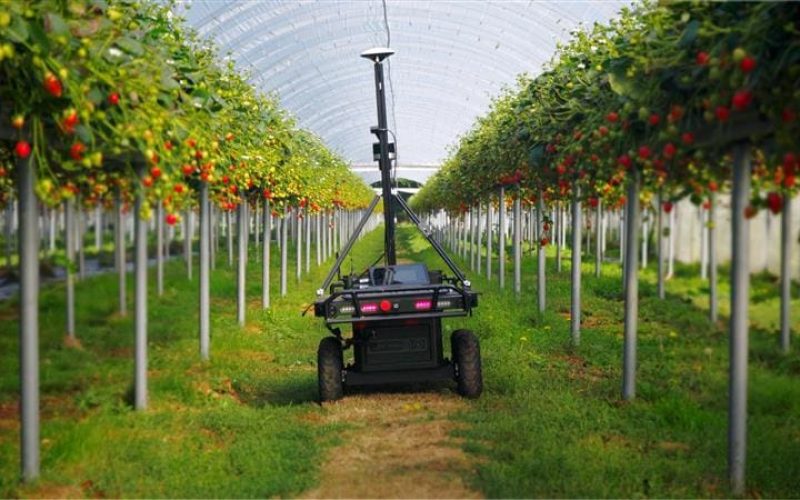
- Intelligent and data-driven agriculture – Deploying AI, robotics and sensing technologies to enable predictive, data-led farm management and precision input use.
- Climate resilience and biotechnology – Integrating precision breeding, early detection and next-generation biological tools to deliver adaptive, holistic management under changing climatic conditions.
- Regenerative farming and agri-tech – Linking bio-based solutions, agri-tech and robust MRV (measurement, reporting and verification) technologies to enhance soil health and create measurable environmental and productivity gains.
- New and diversified production systems – Expanding controlled environment, circular and alternative protein systems to increase resource-efficient, year-round production.
Collectively, these innovation pathways provide a structured framework to guide technology development and practical adoption, helping agri-tech innovators move from concept to market-ready solutions.
Dr Ruth Bastow, Chief Technology Officer at the UK Agri-Tech Centre, said: “Real progress depends on developing and adopting innovation that drives sustainable systems. To grow the UK’s agri-tech advantage, we need joined-up investment, shared infrastructure and a clear vision that aligns science, policy and business. By working collectively across the sector, we can turn technological breakthroughs into practical tools that drive productivity, resilience and environmental gain.”
This report underlines the UK Agri-Tech Centre’s commitment to supporting agri-tech enterprises in developing, testing and commercialising their technologies through access to world-class facilities, expert guidance and strategic partnerships. By uniting researchers, technology developers, producers and policymakers, the UK Agri-Tech Centre continues to play a crucial role in building a sustainable, globally competitive and tech-enabled agricultural sector.
Find examples of our work below:
Accelerating agri-tech: Fotenix
Accerelatng agri-tech: Outfield
Accelerating agri-tech: Gelponics