Transformational tech for dairy industry
The UK Agri-Tech Centre has outlined how they are contributing to transformational technology, innovation and research to help the dairy industry meet some of its biggest challenges.

The UK Agri-Tech Centre has outlined how they are contributing to transformational technology, innovation and research to help the dairy industry meet some of its biggest challenges.

The UK Agri-Tech Centre has taken steps in fostering collaboration with Spain to address challenges & promote sustainable development in agriculture, agroforestry, food and aquaculture.

By bringing together world-class expertise, facilities and knowledge. We’ll be able to create greater cross-sector working opportunities and a systems-wide approach.

The UK Agri-Tech Centre were at the York headquarters, to meet local MP, agri-tech supporter and farmer, Julian Sturdy. Julian is a member of the House of Commons Environment, Food & Rural Affairs Committee and chairs the All-Party Parliamentary Group on Science and Technology in Agriculture. Future Plans We were proud to report our achievements since our establishment in 2015/6, to outline our plans to merge and our future ambitions as a single organisation to create innovative solutions to the sector’s most critical challenges. Since establishing in 2015/6 the UK Agri-Tech Centres, previously CHAP, CIEL and Agri-EPI Centre, have created networks comprising experts and industry involving more than 450 organisations, including research institutes, SMEs and multinational companies. UK Agri-Tech Centre employs ca. 130 expert staff, have invested in world-class facilities through support from Innovate UK across the UK – covering all agri-food sectors – and has been involved in bringing valuable innovations to the marketplace, with many more in the pipeline. Challenges facing the agri-food sector The challenges facing the UK and global agri-food sector are complex and critical. Food and farming are influenced by economic, climate and policy pressures, and innovation and adoption remain a challenge. Four main trends underline the urgent need for the generational change required in UK and global agricultural production and will drive the new organisation’s strategy: It takes a long time to bring agri-tech innovation to the marketplace and the sector requires long-term investment to de-risk the process. The agri-food sector does not have the luxury of time to develop innovative solutions. How we must respond To respond to these complex and interlinked challenges, whilst driving sustainable economic growth we must integrate technologies to create globally competitive systems, create new agri-tech for scale-up and ensure the appropriate skills are available for the future. UK Agri-Tech Centre will continue to work in partnership with industry and wider stakeholders to connect the innovation system, deliver world-leading agri-innovations that sustain the environment and society and maximise global opportunities. If you have any questions about Julian Sturdy or have any general enquiries about UK Agri-Tech Centre, please contact [email protected]

Phil Bicknell, CEO, the UK Agri-Tech Centre: The Genetic Technology (Precision Breeding) Act, which came into being in 2023, is a key piece of post-Brexit legislation that shows how the UK has been able to liberalise agri-tech rules. It supports gene-editing to match the kind of genetic changes that would have occurred over years through traditional breeding methods, effectively speeding things up. Future challenges mean that we’re going to need more rapid and focused genetic improvement than traditional methods have provided for plants and animals. There have already been research advances with flu-resistant poultry due to gene-editing. The second important change, which is in progress, is that the Regulatory Horizons Council has taken a cross-sector look at areas where it can facilitate innovation through regulatory change. One of the most important is around use of robotics and autonomous vehicles. We’re probably all familiar with the challenges of getting labour on-farm, whether employing people to pick fruit and veg in the fields or just getting hold of tractor drivers. So anything that facilitates the use of more robotics on-farm and a future with more autonomous vehicles carrying out routine tasks makes sense. Innovation tends to be ahead of regulation, so sometimes it’s a case of playing catch-up. That’s one of the most important things about three Agri-Tech Centres, CHAP, CIEL and Agri-EPI, coming together and being a conduit for helping the government identify where post-Brexit regulatory changes would have the most valuable impact, whether unlocking further research or facilitating uptake and adoption. Our new merged business will drive responsible agri-innovation at unprecedented levels, securing society’s supply of food, fuel and fibres and stimulating economic growth for the UK and beyond. We are already working on a range of ground-breaking ideas and transformational research projects; our impact in this area will gather pace as a single organisation. Key to the successful creation and adoption of innovation is timely, proportionate and clear regulation which is well communicated. New technology is a big investment, especially for small business and start-ups; any degree of uncertainty stalls confidence, but good regulation sparks a willingness to invest. Supporting case study:Labour shortages, climate change and increasing pressure on productivity in agriculture can only realistically be addressed by increasing automation and digital technology. The Antobot, a robot and app that harnesses AI, transforms UK fruit farm businesses with accurate apple, strawberry and grape yield estimation, real-time crop management and increased resource efficiency, supporting businesses to manage the impacts of climate change on their crops. Soft fruit picking is a key robotics development area, not least as it is difficult to perfect. If you have any questions post Brexit challenges or have any questions, please contact us via [email protected]

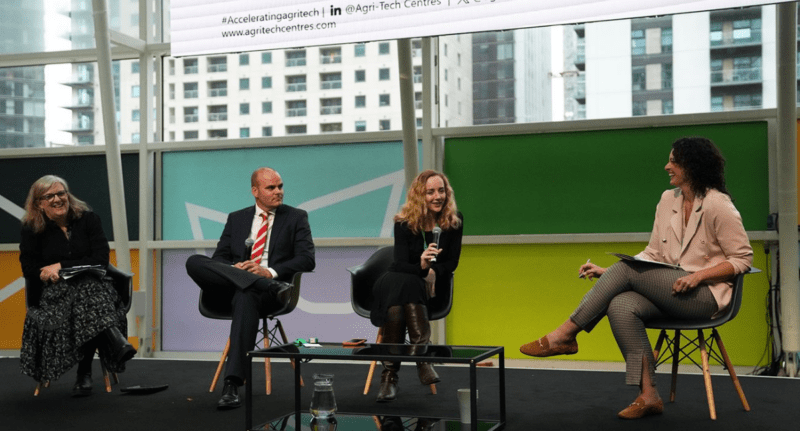
The UK Agri-Tech Centre’s Accelerating Innovation Conference showcased the value of agri-tech innovation, research and development to the agri-industries and wider UK economy. Supporting the Government’s aspiration for the UK to be a Science and Technology Superpower. A key highlight of the conference was the Minister of State for the Department for Science, Innovation and Technology, George Freeman MP’s reconfirmation of the government’s commitment to the agri-industries. As well as recognising the pivotal role that agri-tech innovation has to play in UK economic growth. During his speech, the Minister said: The merger of three Agri-Tech Centres is about enabling long-term stability and security for the sector. We want to develop UK expertise, deliver support for fast-growing companies, and attract global investment. Including the global funds that we know want to invest in UK agri-tech. The combined Centres, which we have invited to put forward a proposal to become a new Agri-Tech Catapult, will be an anchor for that investment and enable all the different areas within the sector, from horticulture to husbandry and arable, to draw on ground-breaking research that’s coming through from engineering- biology and AI, across the Catapult network and beyond, in the UK and globally. The merger of the Centres will provide a major boost to agri-tech innovation in a sector estimated to be worth £13bn to the UK economy by 2027. Speaking after the conference, CEO of Innovate UK, Indro Mukerjee said: The agri-tech ecosystem is fundamental to our economy; we now have an exciting opportunity to accelerate our ability to meet these global challenges and opportunities. We have come a long way towards delivering on our ambitions for this critical sector. The conference today gave a new depth to the value of the merger of the three Centres. Meeting their expert teams and hearing direct from the businesses and the agri-tech community they support, really brought alive what is possible and why now. In developing the plan to become a Catapult, the new organisation will facilitate stronger cross-sectoral working and systems-wide approaches to agri-sector expansion opportunities and sector challenges. It will also enable the sharing of knowledge and learnings across the whole ecosystem and provide access to business support in order to boost the development and adoption of agri-tech solutions. The proposed Catapult will build on the successes of the Centres’ work over the past seven years. During this time, three of the Agri-Tech Centres (now the UK Agri-Tech Centre) have provided an ecosystem for agri-tech to be researched, developed and tested in response to some of the most critical global R&D priorities, working on 350 collaborative R&D projects involving over 500 businesses – from start-ups to global corporates – and delivering a value of £100m to the sector. Speakers from the three merging Agri-Tech Centres – Agri-EPI Centre, CHAP and CIEL – outlined how plans to become a single organisation are developing at pace, detailing how the merger will deliver huge benefits to the agri-industries sector, and to the wider UK economy. By combining the Centres’ UK-wide capabilities, with their world-class research facilities, investment and innovation expertise and extensive networks, the new business will be a hub for innovators to thrive. It will also provide advice and coordination to access critical funding and wider Innovate UK programmes, such as Horizon Europe and the Farming Innovation Programme. Following the Conference, Fraser Black, CEO CHAP, said: Our conference has showcased the huge value agri-tech innovation delivers for the UK agri-industries. We’re delighted to have the support of the Minister of State for the Department for Science, Innovation and Technology, George Freeman MP, flying the flag for the significance of R&D and innovation in growing the wider UK economy. “We are excited to have shared our merger plans with current and future partners. By combining to form a single business, we will boost UK agri-tech and accelerate the development and commercial adoption of proven, viable and sustainable solutions. This will help the agri-industries – across arable, livestock, horticulture, forestry and aquaculture – meet the challenges of securing humanity’s necessities while protecting people, the planet and its resources. If you have any questions about the UK Agri-Tech Centre, please contact [email protected]