
By Polly Douglas and Martin Sutcliffe, UK Agri-Tech Centre
Walking the exhibition halls at Aquaculture UK this year, one thing became immediately clear: aquaculture is entering a new phase of technological maturity.
The move from Aviemore to Glasgow’s SEC was symbolic in many ways. While Aviemore has long been at the heart of the event’s identity, the larger venue reflected an industry that is growing in confidence, attracting new investment and increasingly looking to technology to solve some of its biggest challenges.
What struck us most wasn’t any single innovation, but the sheer volume of technologies now moving beyond the concept stage and into real-world application. Across the exhibition floor and conference programme, conversations centred on artificial intelligence, robotics, automation, advanced sensing and integrated data platforms. These aren’t future possibilities anymore; they’re becoming practical tools that farmers can use to improve productivity, fish health, environmental performance and operational resilience.
For a sector facing increasing pressure to produce more while demonstrating sustainability and maintaining high welfare standards, that feels like a significant shift.
The rise of connected technologies
One of the strongest themes throughout the event was the growing integration of technologies.
Historically, many innovations have been developed to solve individual problems. Today, we’re seeing sensors connecting to data platforms, analytics feeding decision-support tools, and automation systems acting on real-time information. The result is a more connected approach to farm management.
This was reflected particularly strongly in the Innovation Zone, where early-stage companies showcased technologies designed to help producers make faster, more informed decisions.
As our Chief Engagement Officer, Daniel Himsworth, observed during the event:
“Aquaculture UK was genuinely energising. I learned a huge amount and was struck by the pace of innovation across the sector. A real highlight was meeting the next wave of aqua-tech companies in the Innovation Zone – passionate, ambitious and shaping the future of the industry.”
The challenge now is helping those businesses move from promising innovation to commercial impact.
Innovation in practice: from concept to commercial reality
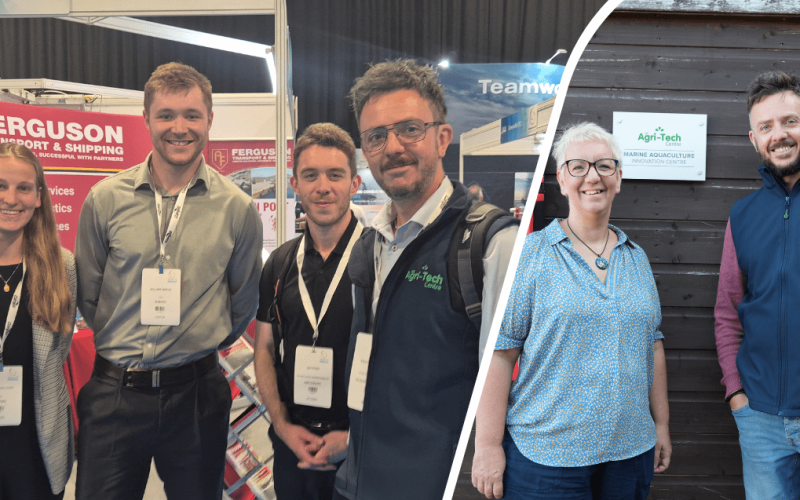
One of the highlights of the event was our “Innovation in Practice” panel discussion, where several companies working with the Marine Aquaculture Innovation Centre (MAIC) shared their experiences of developing and validating new technologies in real farming environments.
What was particularly interesting was how different their technologies are, yet how similar their needs become when it comes to scaling innovation. Whether working with artificial intelligence, machine vision or advanced sensing, all three businesses highlighted the importance of being able to test, refine and demonstrate solutions under realistic operating conditions.
For Rubisko, the focus is on helping aquaculture businesses unlock the value of their data. Co-Founder Will Varcoe explained how the company takes time to understand farming operations in detail before applying technology, ensuring solutions are built around real industry needs rather than technology for technology’s sake.
By bringing together multiple data streams into integrated dashboards, Rubisko is helping farmers gain clearer insights into their operations and make more informed decisions in real time. As the volume of data generated on farms continues to grow, this type of work is supporting more intelligent, AI-enabled farm management systems that can support decision-making, improve efficiency and ultimately help businesses operate more effectively.
Will also spoke highly of the support provided by the team, highlighting the value of working within an environment that understands both the technical and operational realities of aquaculture.
For Ace Aquatec, the conversation centred on machine vision and biomass monitoring. Ben Perry described how MAIC’s adaptable infrastructure and easy access to facilities have provided an ideal environment for developing and testing the company’s biomass camera system.
A particularly valuable advantage has been the site’s exceptionally clear water, which creates excellent conditions for developing camera-based technologies and machine vision applications. As farmers increasingly seek better ways to monitor fish performance, health and behaviour, these visual technologies are becoming an increasingly important part of the aquaculture toolkit. Ben described MAIC as a genuine proving ground, allowing technologies to be tested, refined and validated before wider deployment.
Meanwhile, ANB Sensors demonstrated how advanced sensing technologies are becoming increasingly important in delivering more connected aquaculture systems. Sam Kirby explained how working alongside other technologies within the MAIC environment has helped improve system integration, something that is becoming critical as farms adopt a wider range of digital tools and monitoring platforms.
Just as importantly, exposure to real-world farming conditions has enabled ANB Sensors to make tangible improvements to its product. The experience has accelerated development to the point where the company is now preparing for commercial launch within the coming months – a powerful example of how access to the right testing environment can shorten the journey from innovation to market.
Taken together, these examples demonstrate that innovation in aquaculture is no longer happening in isolation. The future lies in bringing together sensors, data platforms, analytics and automation into connected systems that provide farmers with better information and greater control. Facilities such as MAIC play a crucial role in helping companies bridge the gap between promising ideas and technologies that are ready to deliver impact at scale.
Collaboration remains the catalyst
Technology may have dominated many of the discussions, but one thing hasn’t changed.
The industry’s greatest strength remains its willingness to collaborate.
Events like Aquaculture UK continue to provide invaluable opportunities to bring together producers, technology developers, researchers, investors and support organisations. Some of the most valuable conversations happen away from the conference stage, whether that’s reconnecting with long-standing partners, meeting new innovators or discussing shared challenges over coffee.
It was particularly encouraging to see the breadth of expertise represented at this year’s event, from established businesses through to emerging start-ups developing the next generation of solutions.
That strong sense of community was evident beyond the exhibition floor too. The Aquaculture Awards provided a welcome opportunity to celebrate the people and businesses driving the sector forward. A particular highlight was seeing Alastair Barge, Managing Director of Otterferry Seafish, receive the Outstanding Contribution Award, earning a standing ovation from colleagues and peers across the industry. It was a fitting reminder that while technology may be accelerating change, the sector’s success is ultimately built on the expertise, commitment and leadership of its people.
Looking ahead
If there was one takeaway from Aquaculture UK 2026, it’s that aquaculture’s future will be increasingly data-driven, connected and technology-enabled.
AI, automation, sensing and analytics are no longer niche areas of development. They’re rapidly becoming central to how the industry improves efficiency, strengthens sustainability and supports fish health and welfare.
The opportunity now is ensuring those innovations successfully make the journey from prototype to practical adoption.
That’s where collaboration between industry, innovators and facilities such as MAIC becomes so important.
The technologies are emerging. The ambition is there. The next challenge is turning that momentum into lasting impact across the sector.